




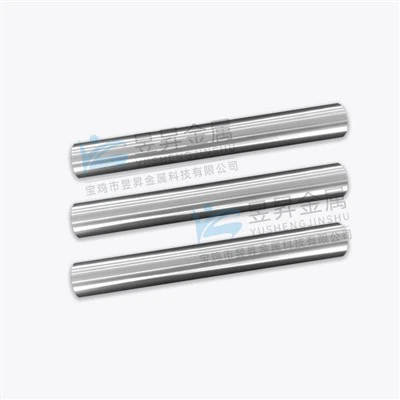
Niobium-tungsten Alloys Nb521 Rod
Zr: 0.75-0.98
Mo:1.60-2.10
W: 4.5-5.1
Products Description
Tungsten is an effective strengthening element for niobium, but as the amount of tungsten added increases, the plasticity of the alloy a brittle transition temperature will rise, the grain also grows significantly. In 1961, the United States developed a successful Nb-10W-2.5Zr alloy for space shuttle skins, which was later developed into Nb-10W-1Zr-0.1C. In the early 1970s, China also Developed successful NbWl0Zr2.5 and NbWl0Zr1C0.1 alloy.
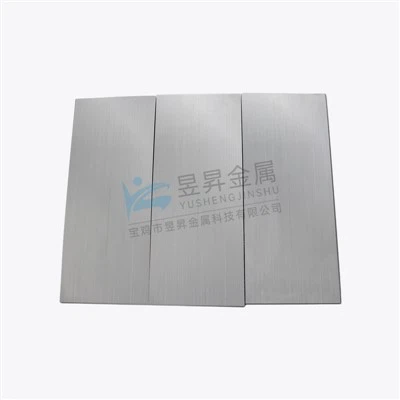
Niobium-tungsten alloys Nb521 Rod can be divided into solid solution strengthened alloys and alloys with a combination of solid solution strengthening and dispersion strengthening according to the strengthening method.
Products The development process
Since 1999, domestic aerospace units have been seeking a new, new niobium-based alloy that can be used at temperatures above 1600°C. Ltd. and the Northwest Institute of Non-Ferrous Metals have developed Nb521 (Nb-5W-2Mo-1Zr- 0.01C) and Nb522 (Nb-5W-2Mo-2Zr) alloys, collectively known as niobium-tungsten alloys.
These alloys use W, Mo and Zr as alloying elements, with the main strengthening mechanism being solid solution strengthening and recrystallisation temperatures of 1350°C - 1500°C. Nb521 also uses 600-1000 ppm of C to form the second phase of NbC and ZrC, using a combination of solid solution and precipitation strengthening methods to improve the strength and processability of the alloy.
Niobium-tungsten alloys Nb521 Rod have a similar density (8.6-9.0 g-cm-3) and better high temperature strength than C103 alloys. However, due to the addition of a large number of strengthening elements such as W and Mo, the room temperature strength of the ingot is higher and the plasticity is poorer. High temperature extrusion is mostly used during ingot processing to refine the ingot grain. After extrusion, the plasticity of the alloy ingot is greatly enhanced, and can be forged, rolled, spun and other processing methods to obtain the required specifications of bars, plates and forgings, spun parts.
Chemical composition of Nb521 Rod Niobium-tungsten alloys
| Composition of Nb521 alloy wt% | |||||
| W | Mo | Zr | C | N | O |
| 5.14 | 1.87 | 1.33 | 0.0095 | 0.006 | 0.010 |
| Cu | Ti | Fe | Si | Ta | Nb |
| 0.001 | 0.016 | 0.001 | 0.0028 | 0.59 | Balance |
| Mechanical features of sheet and bar made of the alloy Nb521. | ||||||
| Sample | σb/MPa | σ0.2/MPa | δ5/% | ψ/% | E1/GPa | Bending angle/(°) |
| Nb521 Rod | 440 | 328 | 31 | 77 | 124 | - |
| Nb521 Sheet | 470 | 340 | 36 | - | - | 180 |
Niobium-tungsten alloys Nb521 Rod Application
Nb521 has high plasticity, making it suitable for spinning and other plastic processing techniques that create parts. It can be applied to engine parts.

We are a source manufacturer with guaranteed quality and full specifications, please contact us for any enquiries.zy@tantalumysjs.com
Hot Tags: niobium-tungsten alloys nb521 rod, suppliers, manufacturers, factory, customized, buy, price, quotation, quality, for sale, in stock, Niobium
Previous
C103 Niobium Alloy WireYou Might Also Like


Send Inquiry