




Nb-Ti Capillary Tube
The superconducting industry has adopted our niobium-titanium alloy wire, tubes, and other items.
Please contact us for more information.
Application of common Niobium Titanium alloys
An very significant alloy, 50%Nb, 50%Ti is a superconductor at temperatures lower than 43K.
The most popular application of these Nb-Ti Superconductors in the market is to manufacture Nuclear Magnetic Resonance (NMR) scanners used in medical institutions. Light fasteners for airplanes are made of Nb-Ti alloy (Nb-45% Ti).
Future nuclear fusion reactors, high-speed maglev trains, magnetohydrodynamic (MHD) power plants, and the storage and transmission of subterranean capacity are the main sources of demand for niobium superconductors. In the future, Niobium Superconductors may face competition from more sophisticated superconductors (such high Te superconductors).
Nb-55Ti can be used in anti-corrosion engineering. When filtering gold and nickel in high-pressure equipment, Nb-55Ti is used.environment with a high oxygen content.In this setting, niobium also works as a flame retardant. Niobium-containing titanium alloys, such IMI367, are utilized to make femoral components for hip replacement surgery and other surgical implants.
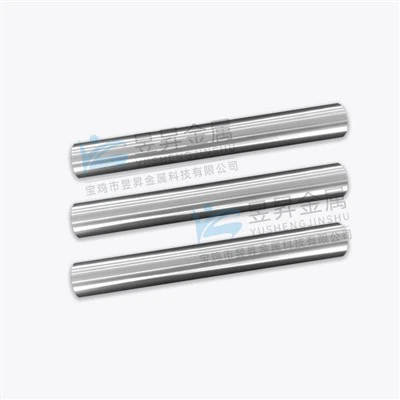
Niobium Titanium capillary tube
Nb-Ti capillary tube composition: Ti-45Nb, Nb53%Ti47%, Nb-50% Ti
Specification of Niobium-Titanium capillary tube:
OD1mm X Wall Thickness 0.14mm X 1000mm
OD1.4mm X Wall Thickness 0.14mm X 1000mm
OD2.2mm X Wall Thickness 0.18mm X 1500mm

The ingredients of the superconducting Nb-Ti Capillary Tube are Mg, B, La, Ti, and residual Nb. Niobium sheet and titanium sheet are first melted, followed by the addition of magnesium bar and boron particles for further melting to produce an ingot. La is then added for refining to produce an electrode rod, which is then smelted by a vacuum consumable electric arc furnace to produce the resulting ingot, which is then heated and forged. The tube blank was then annealed, and the capillary tube was made by repeatedly reducing the diameter.The low-temperature superconducting Nb Ti alloy capillary of the invention has a high degree of purity, no pores, a dense structure, fine and uniform grain, and an average grain size of less than 60 m. The preparation technique is practical and easy to use at the same time.
Science and technology advancements have led to significant advances in the study of novel materials and the superconductivity theory. Yet, the majority of superconducting materials with significant practical use in the context of current technology are alloys or compounds. Nb-Zr and Nb-Ti are the most widely utilized superconducting alloy materials on the domestic market, and they are primarily employed in the production of various types of magnets, as well as superconducting power lines, communication cables, and electrical components. The findings demonstrate that the composition, microstructure, and electronic structure of Nb-Ti alloy materials, as well as the internal force between electrons and lattice vibration, are the main factors affecting the critical temperature Tc, critical magnetic field Hc, and critical current density Ic of Nb-Ti superconducting materials.Controlling the composition, inclusions, precipitates, dislocations, and composition inhomogeneity of alloy materials as well as the interior microstructure is crucial.

The Nb-Ti Capillary Tube produced by the invention is preferably smaller than 3mm in diameter, 0.1–0.3mm in wall thickness, and 1–10m in length. The high melting point Nb non-melts are eliminated through secondary vacuum melting in the process of making the aforementioned low temperature superconducting Nb-Ti alloy capillary tubes to increase the homogeneity of micro and macro components. In order to improve the flexibility of the niobium-titanium alloy and make forging easier, additional gas is removed while impurities, particularly those with a high density, are evaporated in the vacuum consumable electric arc furnace.Additionally, the tube blank is vacuum annealed before being reduced in size by cold drawing. This prevents the alloy from oxidizing during the annealing process. Additionally, the grain is refined, the grain size is more uniform, the alloy has improved plasticity, the work hardening rate is decreased, and multiple vacuum annealing can improve the uniformity.
Hot Tags: nb-ti capillary tube, suppliers, manufacturers, factory, customized, buy, price, quotation, quality, for sale, in stock, Niobium
You Might Also Like



Send Inquiry