




Niobium-titanium Superconducting Joints
The connection between quantum technology and superconductivity
Quantum computing and communication rely heavily on superconducting items like niobium titanium capillary tubes.
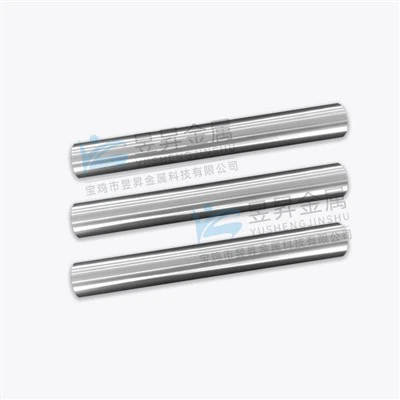
Niobium Titanium capillary tube
Material of Nb-Ti capillary tube: Ti-45Nb, Nb53%Ti47%, Nb-50%Ti
Specification of Niobium-Titanium capillary tube:
OD1mm X Wall Thickness 0.14mm X 1000mm
OD1.4mm X Wall Thickness 0.14mm X 1000mm
OD2.2mm X Wall Thickness 0.18mm X 1500mm
Niobium Titanium superconducting joints
Due to the zero resistance of superconducting materials, Niobium-titanium (Nb-Ti) superconducting joints are commonly used as superconducting cables in the power industry.
In order to provide an ultra-stable magnetic field, persistent-mode operation in a superconducting magnet system requires superconducting joints. Here, we provide a detailed report on the evaluation of niobium-titanium superconducting joints that have been rationally constructed. Two types of lead-bismuth (Pb-Bi) solder, including Pb42Bi58 as a novel composition, were used in a solder matrix replacement technique to create superconducting junctions for practical applications. At 4.2 K, all joints reached a critical current of greater than 200 A. In a closed-loop coil test, our improved superconducting joining technique produced a total circuit resistance of 3.25 1014 at 4.2 K in self-field. Last but not least, persistent-mode operation in a Nb-Ti solenoid coil with a persistent-current switch was shown.This research will open the door to the creation of high-performance Nb-Ti superconducting joints for real-world use.
It is not possible to create a powerful magnetic field in a small space using ordinary copper (Cu) based magnets, but superconducting magnets can. Superconducting magnets are often made of niobium-titanium (Nb-Ti), which has a critical temperature (Tc) of 9.2 K and is used in a variety of real-world applications. The ability to create trustworthy "superconducting joints" is one of the distinctive characteristics of Nb-Ti that makes it suited for the majority of commercial applications. The Nb-Ti magnet may function in the persistent mode and achieve an ultra-stable magnetic field (long-term drift rate of the magnetic field on the order of 0.1 ppm/h) thanks to the superconducting joints1.


The two ends of a Nb-Ti superconducting magnet should be connected to a persistent-current switch (PCS) utilizing Niobium-titanium superconducting joints in order to enable persistent-mode operation. The fabrication of the superconducting connections of Nb-Ti conductors has been reported using a variety of techniques, including solder matrix replacement2,3,4,5,6, ultrasonic welding7, diffusion welding8, cold pressing9,10, and spot welding10,11. From a reliability standpoint, the solder matrix replacement technique using lead-bismuth (Pb-Bi) solder, which is superconducting at 4.2 K, is frequently used in industrial settings to create Nb-Ti joints11.Thornton reported the first high-performance Nb-Ti connections made using the solder matrix replacement technique in 19862. In self-field at 4.2 K, a closed-loop with a single joint that was constructed outside was able to reach a critical current density (Jc) of up to 143 kA/cm2. The resistivity of various Nb-Ti junctions created by Swenson et al. using the Thornton approach was evaluated using the conventional four-probe technique3. They were able to attain joint resistances of 1 1011 in 1 T at 4.2 K. Results on numerous Nb-Ti joints for a 400 MHz nuclear magnetic resonance magnet were also reported by Cheng et al.In a closed-loop experiment, one of their joints reached a critical current (Ic) of 89.5 A and joint resistance of 1.8 1013 in 1 T at 4.2 K. For a 7 T animal magnetic resonance imaging (MRI) magnet, Liu et al. also created and examined Nb-Ti joints5. Its joints, which were made from 1.5 1 mm2 Nb-Ti/Cu wire, had an Ic of 1,160 A and 1.5 1014 in 0.6 T at 4.2 K. More recently, in 2015, Motomune et al.6 investigated the current pathways in Nb-Ti junctions created by replacing the solder matrix.Despite the fact that Nb-Ti superconducting joints are frequently made in the MRI sector and are an essential part of MRI magnets, there hasn't been much research on the superconducting joining techniques for multifilamentary Nb-Ti conductors.


In response, two varieties of Pb-Bi solder were assessed in this work in terms of their Jc and Tc as viable possibilities for Nb-Ti superconducting junctions. SEM was then used to determine the ideal etching time for the Cu matrix with tin (Sn) and Sn with Pb-Bi (SEM). These results led to the fabrication of superconducting joints in a largely inert atmosphere to prevent oxidation and their characterization at 4.2 K in various magnetic fields. A single-turn Nb-Ti closed-loop coil was made and tested using the field-decay measuring method in order to accurately determine the junction resistance. By showing persistent-mode operation in a prototype Nb-Ti magnet, persistent-mode functioning in the newly constructed Niobium-titanium superconducting joints for a persistent-mode magnet was confirmed.


Conclusions
We have described a solder matrix replacement method for superconductingly attaching a multifilament Nb-Ti conductor, together with test results for the superconducting junctions. The first step was to confirm the compositions of two Pb-Bi solders, Pb44.5Bi55.5 and Pb42Bi58, which may have an impact on their superconducting capabilities. Both solders had a Pb deficit of up to 1.6%. The magnetic Jc of Pb44.5Bi55.5 and Pb42Bi58 was found to be 2.9 103 Acm2 and 1.19 103 Acm2, respectively, in 1 T at 4.2 K, but the Tc (onset) of 8.5 K was measured for both solders.The best performance ever reported was the Jc of Pb44.5Bi55.5. The Ic of one of the best joints made with Pb44.5Bi55.5 was 136 A in 1.65 T at 4.2 K. The results of the magnetic measurement were consistent with the subpar performance of the joints created with Pb42Bi58 in comparison to Pb44.5Bi55.5. Also, we noted that achieving high joint performance was not favored by loose Cu wire binding in the joint. The joint was constructed with a single-turn Nb-Ti closed-loop coil so that the field-decay measurement could be used to calculate the joint resistance exactly. The measured total circuit resistance, which complies with the technical specifications for persistent-mode operation, was 3.25 1014 in self-field at 4.2 K.Lastly, a Nb-Ti solenoid coil with two joints and a PCS was used to show persistent-mode operation. The development of high-performance Nb-Ti superconducting joints will be made possible by the methodical investigation and findings on the Niobium-titanium Superconducting Joints procedure reported in this paper.
Hot Tags: Niobium-titanium Superconducting Joints, suppliers, manufacturers, factory, customized, buy, price, quotation, quality, for sale, in stock, Niobium
Previous
Nb-Ti Capillary TubeYou Might Also Like




Send Inquiry